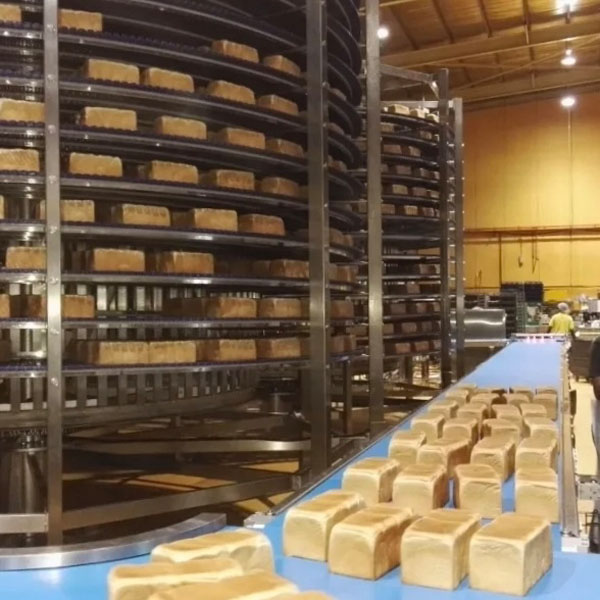
In modern automated bakery production lines, consistent, hygienic, and uniform post‑baking cooling is one of the most critical processes that directly determine final food quality, shelf life, and production efficiency. Traditional manual cooling platforms and flat cooling conveyors often cause uneven temperature dissipation, surface dryness, product deformation, and long idle waiting times, limiting large‑scale continuous bakery production. As the ideal upgraded cooling solution,spiral cooling conveyors have become standard equipment for professional bakery factories worldwide.
1. How Spiral Cooling Systems Work for Baked Goods
After high‑temperature bakery products such as bread, cakes, pastries, and mooncakes exit the oven at 180–220°C, they directly enter the spiral cooling conveyor without manual transfer. The equipment adopts a vertical multi‑layer spiral conveying structure, allowing baked goods to travel slowly along a long, continuous spiral mesh belt path. Through circulating natural air or forced clean air convection, heat is evenly dissipated from both the surface and the core of the food. The fully enclosed design ensures stable airflow and dust‑free cooling environments, achieving precise and gradual temperature reduction.
Compared with flat cooling lines, the spiral structure greatly extends the cooling distance within a compact floor area, ensuring sufficient heat exchange time. The cooling speed and operating frequency can be adjusted according to product types, realizing intelligent and standardized cooling for all kinds of baked food.
2. Core Advantages for Bakery Cooling Applications
Uniform and Stable Cooling Effect
Traditional cooling methods easily lead to large temperature differences between the food surface and center, resulting in incomplete internal heat dissipation, easy mildew, or short shelf life. Our spiral cooling conveyor forms an all‑round uniform air circulation system, controlling internal and external temperature differences within 3°C. Baked products can be steadily cooled from high baking temperature down to room temperature within the set time, avoiding product cracking, deformation, and residual heat softening.
High Space Utilization and Continuous Production
Bakery factories usually face limited workshop space. The vertical spiral design saves more than 70% floor space compared with traditional horizontal cooling lines while supporting 24‑hour uninterrupted continuous operation. It perfectly connects oven output, cooling, and packaging procedures, completely eliminating manual turnover and greatly improving overall production efficiency.
Food‑grade Hygienic Structure
All contact parts adopt food‑grade 304 stainless steel mesh belts and fully sealed frames, which are rust‑proof, high‑temperature resistant, and easy to clean. The smooth mesh belt structure prevents residue accumulation and effectively avoids secondary pollution during the cooling process, fully meeting strict food safety production standards.
Wide Compatibility with Bakery Products
The spiral cooling system is suitable for all types of baked food, including toast bread, buns, cakes, cookies, pastries, and festive mooncakes. By adjusting conveyor speed, cooling time, and air volume, the equipment can meet customized cooling requirements for different sizes, textures, and production capacities.
3. Improve Bakery Product Quality and Shelf Life
Reasonable gradual cooling is the key to improving the taste and shelf life of baked goods. Rapid and uneven cooling will cause hardened bread texture and cracked crusts, while overly slow cooling will lead to moisture deterioration. The spiral cooling conveyor provides a gentle and constant cooling environment, locking in the soft texture, fresh flavor, and stable appearance of baked food. Standardized cooling also reduces product defective rates and improves overall factory output benefits.
4. Intelligent and Low‑Maintenance Industrial Solution
Equipped with frequency conversion speed regulation and stable driving systems, our spiral cooling conveyors feature stable operation, low noise, and low energy consumption. The modular structure is convenient for daily cleaning, inspection, and maintenance, reducing long‑term operating costs for bakery enterprises. It is an ideal supporting device for medium and large automated bakery production lines.
Conclusion
As the bakery industry moves toward full automation, standardization, and high hygiene standards, spiral cooling conveyors have replaced traditional cooling methods and become indispensable core equipment. They solve the pain points of uneven cooling, low efficiency, large floor occupation, and poor hygienic conditions, helping bakery manufacturers achieve stable product quality, higher productivity, and safer food production processes.